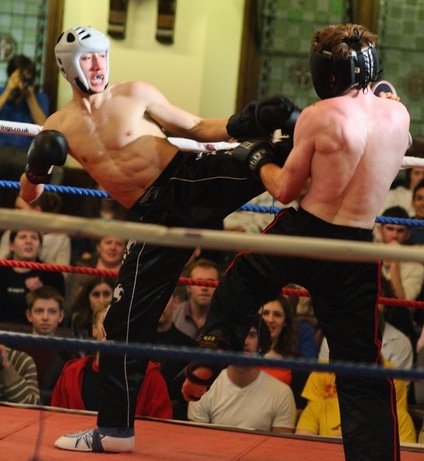
Hook kick: 5 good reasons to hit with the ball of the foot

Courtesy and Copyright © Duncan Grisby 2006

Courtesy and Copyright © Duncan Grisby 2006

Different schools and styles of martial arts teach the hook kick (also called reversed round kick) in different ways. Main differences manifest essentially in the way the movement originates, how the kicking leg is moving during the kick and what part of the foot hits the target that can be the hill or the sole/ball of the foot.

When I teach how to perform a hook kick, I first clarify that to maximise performance the leg should follow a whipping movement to ensure maximum acceleration of the foot toward the target.

I also suggest to always hit with the ball of the foot. Here are for 3 good reasons both physiological and in terms of pure performance for doing that rather than the (side of the) hill, keeping the foot at 90° to the ankle:

  1. better reach: having the foot extended it increases your range by nearly the full length of your foot ensuring you will hit, from the same position, targets that would not be reachable if you bend your foot.
  2. stronger impact: if the angular speed of the leg moving is constant having a longer weapon (by the length of the foot) increases the speed of the foot itself, build up a higher momentum and delivers a stronger kick..
  3. safer for you: the Achilles’ tendon is a weak point and if you squash it against a skull it will hurt your foot to the point you might not be able of walking for some time. Even if the impact is not straight on the Achilles’ tendon it can still hit the many nerves that are exposed both on the internal and external part of the hill, moving toward the ankle. The ball of the foot is very well padded and can bear much stronger impact than the edge of the hill.
  4. improve flexibility: with the full fully extended the natual flexibility of the leg is highly helped; to the contrary trying to extend a leg while the tibial (shin) muscles are tensed in order to keep the ankle at 90° will have some groups of muscles that are fighting against the direction of your kick getting the muscles behind the leg less prone to extend
  5. faster: if all muscles involved in the movement are pushing in the same direction and the others are simply relaxed the overall speed will be improved.

In terms of pure power the hook kick is not to be considered at the top of the scale where round kick and other forward kicks can develop much stronger impact. Things change when spinning backward where the whole spinning momentum adds up to the actual mechanical movement of the kick itself.

Extra information about the hook kick can be found by checking this video:

As usual, any comment is highly appreciated.

Posted under educational, styles, video_review

Written by massimo on 13 Oct 2009

Differences between Kickboxing and Thai Boxing

Many people, too many people, confuse Kickboxing with Thai Boxing (also called Muai Thai): perhaps it is because of the generalization that many schools do in defining any fighting sport that uses upper and lower body strikes (e.g. punches and kicks) as Kickboxing.  I used the term fighting sport to indicate a martial art that gets practiced according to some sport rules: these rules define, among other things, what can be used as a striking weapon and what areas of the opponent’s body can be hit.

In general the correct definition for Kickboxing is what is also called American Kickboxing, the style initially defined in the late sixties / early seventies as Full Contact Karate.  The pioneers of this sport where people like Bill Wallace, Joe Lewis and Benny Urquidez: they eventually renamed it Kickboxing to indicate a Boxing fight with added kicks when got into disagreement with the traditional Karate people that were (and are) still fighting with little or no contact.  Several other styles get called Kickboxing while being obviously something else: Thai Boxing, topic of this post, is the typical example but Savate, a French style with some obvious differences gets called Kickboxing and even Sanda, a sport application of Kung Fu gets sometimes called Chinese Kickboxing.

Although there are some very obvious differences between Kickboxing and Thai Boxing I will try to make them very obvious for the neophyte:

  • Kickboxing is American and Thai Boxing is Thai… not that easy to spot to the untrained observer but the most obvious aspect of this difference is in the uniform that is generally adopted although there are exceptions.  The former one uses (and imposes during tournaments) long trousers while the latter uses broad silk shorts, usually in very bright colours.
  • Kickboxing uses the same range of punches from standard IBF Boxing plus back fist and knife hand strike together with all most obvious kicks: front, side, round, axe and so on, including all variations of jumping, spinning back.  Thai Boxing allows all of the above and adds elbow and knee strikes: in reality knees are considered kind of preferential weapon and they tend to deliver a high percentage of the most devastating blows.
  • In Kickboxing you cannot grab and hold any of the opponents limbs or body parts: Thai Boxing allows for example grabbing the opponent’s leg and hold onto it while striking at the rest of the body; it is also allowed to clinch and strike at the same time.
  • Kickboxing’s techniques can land on the opponent’s torso, face and head: no strikes are allowed to the legs, back or back of the head.  Thai Boxing can strike everywhere excluding the groin area.
  • Kickboxing is practiced wearing full protection kit made of gloves, mouth guard, groin guard, shin and foot pad: Thai Boxing fighters wear just gloves, mouth and groin guard.
  • Kickboxing’s competitions can follow Semi, Light or Full contact rules: Thai Boxing just applies to Full contact.

Just because video are better than words, now that a bit of explanation has been offered please have a look at these two examples I found.  The first is a friendly demonstration fight between Bill Wallace and Dominique Valera: please notice the variety of techniques and how spectacular they look.  If they were in a competition they would have been less spectacular and much more violent:

The second video shows a Thai Boxing fight.  Although the number of techniques available to Thai Boxing fighters is larger than most of the other fighting sports the actual number of techniques effectively used is generally smaller:

I hope you enjoyed this post and the video I selected as examples: any comment is, as usual, highly appreciated.

Posted under styles, video_review

Written by massimo on 2 Sep 2009

Tags: , , ,

Differences between Aikido and Tae Kwon Do

I met yesterday a guy and our conversation drifted very quickly into martial arts (surprise!), specifically about self defence.  I was confused when he stated that he wanted to learn Tao Kwon Do for self defence because a friend of his is a high ranked student of the discipline.  My first reply was: “TDK is mostly based on high kicks, really not ideal for self defence and then, also, you are 37 years old reasonably large and heavy male, TKD is ideal with people with lot of flexibility in their legs and trying to achieve it at this age might be tricky”.  He continued with his explanation that in ideal situation he would like to be able to seize the opponent’s attack and avoid striking but simply locking his attacker in a way that would be impossible for him to hurt any further but without risks of injuring him too much.  I then added that what he was talking about was possible doing Aikido, or Ju Jitsu or other styles not primarily based on strikes… and there he came out with: “oh!, yes, Aikido, I meant Aikido, this is what my friend is an expert of…”.

To me somebody that confuses Aikido with TKD is like confusing a steak with a salad, both food but very different in content. So what are the main differences that a neophyte should look out when checking a class, of either Aikido or TKD?

Let’s list the main ones:

  • Aikido is Japanese; TKD is Korean, well no easy to spot by observing them :-)
  • In a Aikido class you’ll see most people in white Gi, perhaps with coloured belts and the higher ranked people and the masters will wear a black hakama, a very broad pair of trousers that look like a skirt;  in a TKD class they wear white Gi, with coloured belts but their top is some times a “V” neck long sleeves shirt.
  • In Aikido you see people twirling and twisting, throwing and applying arm and wrist locks: people fall and fly around a lot; in TKD opponents are striking each other, mostly with kicks to the upper part of the body (sport rules forbid kicks below the belt).
  • Aikido is mainly defensive, e.g. it starts working when an opponent attacks you; TKD is based on attacking with strikes.
  • Aikido’s techniques can be subtle and usually require a very long time, several years, to be practiced to a level of proficiency to be useful in self defence; TKD can start to be effective with some of its techniques within a few months or a year of practice.
  • Aikido teaches, apart from the bare hand practice, the use of various weapons like sword and staff;  TKD is purely based on bare had strikes.

I have chosen and selected 2 videos to show what Aikido and TKD look like.  It was harder than I thought as many are dispersive and not representative enough.  Please keep the volume down and ignore the part of the TKD video from the boxing ring onward:

Posted under self defence, styles, video_review

Written by massimo on 29 May 2009

Tags: ,

My Thoughts about Wing Chun

Massimo & Alan during a Wing Chun seminar in 2005I have been practicing Wing Chun (WC) on and off for several years and I was lucky enough to be exposed to 4 different lineages of this art, each of them slightly different and each of them asserting to be the best.  My deepest knowledge is in the Austin Goh system that I have practiced regularly for nearly 4 years.  I consider myself an intermediate practitioner of WC and I enjoy training it occasionally and using some of its basic principles in everything I do when practicing martial arts.

When I first heard of WC, in the early nineties, I was at the beginning of my exploration journey in different martial arts.  Growing up in a small provincial town with just a Judo, Karate and Kickboxing school there wasn’t much to learn about other martial arts.  And while videos were simply not available (or unaffordable) there was no Internet that allowed having a look around.

In 1991 while speaking to a colleague from another town I found out about the existence of WC.  The description I received about this martial art was somehow confusing and the concepts described were just not possible to be visualized, at that time.  The fact that many school teach to their students to avoid giving demonstrations or in depth explanations of what and how they practice doesn’t really help, does it?

Description

If you have experience in various styles of Kickboxing, Karate, Tae Kwon Do, Tang So Do and Kung fu you will realize that, more or less, kicks are kicks, punches are punches and stances are stances.  More emphasis here or there but you can see a common line of evolution and many commonalities.  Discussing WC you hear concepts like sensitivity, touch reflexes and central line and that can be a bit disorientating.  The guards and the stances are initially awkward but every makes sense once you get used to it and you have a full grasp of the whole picture.

A fundamental concept of WC is contact training: the average distance of two people practicing with each other is about the one of their elbows extended forward and when practicing you are always in contact with your partner.  You always work with both hands keeping in touch with your opponent’s arms and each technique is always meant to strike: even when certain moves are erroneously classified as blocks they can always be used to attack.

WC is ideal for short distance fighting and for this reason the expert practitioner will seek the short distance by bridging the gap (distance when opponents cannot touch each other) and get to a distance where kicks would be difficult to use.  Being a martial art orientated to fighting and self defence kicks are minimally used and limited to the waist and below (groin, knee cap, leg in general).  Depending on the style there is more or less emphasis on kicking techniques but literally negligible compared to other styles.

History (inspired from the WC Federation site)

WC is a subtle and complete system of Chinese Kung Fu, developed over hundreds of years, with its roots in the Shaolin Temple tradition. Legend has it that in 1645 a Bhuddist nun by the name of Ng Moi devised the system and taught it to a young girl called Yim WC, who successfully used her newly learned skills to defend herself against a local bully who attempted to rape her.  Originally a very secret system, the sophisticated art of WC was only passed on to family members and close, trusted friends. It was only when the legendary Grandmaster Ip Man (now sadly passed away) arrived in Hong Kong that the style was taught more openly.  Ip Man happened to teach to the early Bruce Lee that started to teach WC as soon as he arrived in USA and then it used it as the basis for his Jeet Kune Do and he depicted the art in several famous movies.

What I like about WC

Here are the main points on which I advocate WC to be a great martial art:

  • WC is a no frills, very immediate and direct martial art: it can be practiced effectively by people of any shape, body shape and size and it can be very useful ad a practical self defence system.
  • The contact training allows metabolizing the adrenaline and stress of fighting at a very short distance: you learn to cope with fear and minimize your reactions to any kind of attacks.
  • The way techniques are usually taught help relaxing and most muscles in a position and status that allow maximum reactivity at fast speed while instinct would suggest stiffening and becoming slow.

What I don’t like about WC

There aren’t many things I don’t like about WC as a martial art but, to keep my tradition in “My Thoughts about …” I will list a couple:

  • The level of fitness required to practice WC is substantially lower that other more physical styles: this means that while it will keep your body in decent shape you will have to integrate WC with something else if you want to be super fit.
  • I also dislike and disapprove the too many political actions between the various schools, driven by mere personal interest of a few top guys.

Conclusions

WC is a great martial arts; it teaches very clever concepts that can be applied to the practice of many other martial arts.  I would suggest to anybody, whether she is a total novice or an expert black belt to give it a try, with an objective view.  Make sure to find the right school though.   Some of them are not too friendly and they have a very arrogant way of positioning themselves: I was lucky enough to meet some of the good ones but I heard of some very bad…

Posted under styles

Written by massimo on 20 May 2009

Tags:

The puncher, the kicker and the kick boxer

Boxing is about punching: boxers have a reputation for amazingly strong punches, well known among all fighting sports.  The reality is simple: boxing is limited to 4 basic punches to be delivered with large padded gloves and that has helped the techniques and the training to evolve to its maximum efficiency.

On the other hand Tae Kwon Do is a martial arts (and fighting sport) that is nearly fully based on kicks.  TKD fighting allows full contact for kicks and, quite strangely, controlled contact for punches to the head.

For a long time I kind of assumed that if someone could do boxing training and then TKD do training would be a good puncher and then a good kicker, therefore a good kick boxer.  A few weeks ago I had the opportunity to realise that my thinking was flawed when LK joined my club.  He was fitting perfectly to the above description: 2 years of TKD and over a year of boxing.

While in principle this person knows how to punch and kick very well I immediately noticed a peculiar behaviour in his approach to sparring: he would either kick, nice combinations, while maintaining a pretty poor guard, typical of TKD fighters; in other circumstances he would get close and punch like a real boxer.  It then occurred to me that his training, his knowledge of fighting, was lacking a fundamental part of what kick boxers rely on: articulated combinations of punches and kicks so he would do either or but never combined.

Ultimately, because sparring should be spontaneous and without thinking his subconscious either relies on the punching combinations he known from boxing or from the kicking combinations from TKD but he never mixes and bridges between the two.  It will be a while before alternating kicks and punches will be natural to him.

Posted under styles

Written by massimo on 4 May 2009

Tags: ,