Bill Wallace, Massimo Gaetani and Paul Barnett at Trinity College Cambridge
I recently had the opportunity of spending an entire day, including a 2 hours workshop, with Bill ‘Superfoot’ Wallace and here are some of my impressions about my time with this legend of modern martial arts. It all started when Paul Barnett, a karate teacher which acts as his agent, contacted me offering a possible date for a seminar that I accepted without hesitation. I previously met Superfoot in 2011 at a workshop organised by Colin Payne down in Kent but the opportunity of having him in my club with my students and instructors was not to be missed.
Bill arrived at London Heathrow with an overnight flight landing at 5:55am; Paul collected him and drove straight to Cambridge where they arrived just before 8:30am. I was waiting for them at my clinic. Bill recognised me from our previous, albeit very short and crowded encounter, but it was immediately as if we knew each other for a long time. As he was very tired and jet lagged I allowed him to have a nap in one of our therapy rooms.
He woke up at about midday and we went together for lunch and then a coffee in town while visiting a couple of Cambridge Colleges. The afternoon went by pretty fast and it was soon time for our workshop that lasted about two hours where Bill run through the basic concepts of his ‘Superfoot’ system and he was explaining how he kept winning fights in his career of undefeated 6 time world champion of Full Contact kickboxing.
Bill is in late 60es and when you see him on the street he looks like a man of his age in a very good shape. When he gets changed and starts warming up he just transforms in a different person; he is more flexible than most people I know and can kill with a speed and accuracy that must be seen live.
After the workshop we went out for dinner and it was about 9:30pm when Paul called it the day and moved on to their next destination for the workshop they planned for the second day of Bill’s 9 days staying the UK.
All of my students and instructors were thrilled by the idea of training with such a legend before we started. After the workshop, they all confirmed how Bill exceeded any expectation. There is no doubt that training with a legend like Bill ‘Superfoot’ Wallace is great from a technical point of view, for any martial artist that uses kicks. However I gained more insights about his philosophy of life and training than I actually learn new techniques or strategies to win fights. It’s great to speak to him about how he met and/or trained with a huge range of celebrities within the martial arts, sports fighting and show business: Bruce Lee, Elvis Presley, Dan Inosanto, Dominique Valera and Benny Urquidez just mention a few. The fact that at 67 he still training regularly and runs between 80 and 100 workshops per year in 2 continents is a great inspiration for all martial artists that, like me, are aiming at training until old age. I hope there will be other opportunities to have a seminar with Superfoot in the near future; in the mean time I can say he really made my day.
I saw the other day this very inspirational video from Benny “the jet” Urquidez and after some initial hesitation I literally had to write something more than a little compliment note. I always considered myself a martial artist more than a fighter; for me learning and being good at techniques was and is more important than simple beating up people. However, martial arts are about fighting and being at ease with it is essential, in order to put in practice what we learn from a technical point of view.
Some school push the fighting concept to the extreme and just spar all the time; these school often produce aggressive fighters that might have an easy early career but then face the reality of other aggressive fighter which are also technically very good. Other schools simply use excuses like “what we do is too dangerous and we cannot practice it” and just don’t spar at all. I mentioned in previous posts the importance of realistic training as well my view about fighting and winning.
In this short video Benny “the jet” highlights fears and worries that many people have when they start sparring and just by keep training, perhaps by asking to some people to go easy of you until you get better, will help you learn and improve your sparring technique and, eventually, become a champion if that’s what you aspire to. By sparring your friends you will learn to fight and win against your inner demons that ultimately are the ones who are slowing you down and hindering your fighting skills.
This is the last post of 2012 and the title I chose for it is one the sentences that made Bruce Lee famous when, during an interview in the late sixties, he stated that:
“Water is inessential in terms that you cannot grasp it or hit it and damage it; it can drip or crash. If you put water in a pot it becomes the pot if you out it in a glass it become the glass. Be water my friend!”
This concept is well explained in many eastern philosophies: water and its versatility as well as its destructive power when floods or tsunamis occur are usually used as examples.
The concept of being water or behaving like water is in fact well known and broadly used among many Taoists authors and scholars. Bruce Lee made this concept famous because he was the first celebrity at that time speaking about ancient Chinese philosophy during TV interviews.
My thought for today is: when practicing martial arts, while punching, kicking and performing whatever other technique how often do we actually stop and think about this concept? Do we ever do it? Is this a concept we should actually think about when training or it should be used as one of the basic principles on which we base our lives in martial arts?
Happy New Year to everyone! I hope 2013 will bring great new things to yourselves and those who are close to you.
Many martial arts techniques require actions that involve groups muscles that are not usually used in any other everyday’s activity; let’s we consider for example:
round kick to the head from tae kwon do
chain punches from wing chun
harai goshi from judo
Each of the above mentioned techniques are part of the basic training for their respective martial arts and yet, they involve several groups of muscles, at a high speed and in perfect synchronization and it could be quite challenging for a novice.
Achieving top performance in any of these moves (or any other technique) usually requires what implicitly most martial schools teach as part of their standard curriculum:
the technique is shown by the instructor
the student tries it and familiarise with the various aspects of the move: starting position, foot work, shifting weight in the right direction and at the right time, maintain a proper guard during the technique and the ending position
once repeated a few times the instructor feeds back some suggestions about adjusting what is not working and the technique is repeated more times until a decent level of performance is achieved
I have been using successfully the approach described above with thousands of students; for some decently co-ordinated people techniques just come natural and everything simply works. However there are people that struggle to learn a complex move at ones so they get overwhelmed by the whole process or frustrated by the lack of achievement.
If one of my students encounters this kind of difficulties I implement what I am here defining a progressive approach for improving performance. When we are learning a new technique the aim should be to achieve unconscious competence, when your technique just flows without conscious effort. Before achieving that state we need to work, consciously on the technique and repeat it until it becomes automatic.
My approach follows these steps:
quickly establish what is already working in the technique
isolate one or more aspects that need improvement
instruct the student to focus his/her attention just on one aspect of the technique at the time until that works
repeat <3> until all non working aspects have been worked on and improved
finally perform the whole improved technique a few times to focus on the positive outcome and ensure it pushed at subconscious level
A typical example of the above process applies well to people that, when kicking front kick, drop or open their guard. So here is the application:
quickly establish what is already working in the technique: the kick is ok but the guard is not
isolate one or more aspects that need improvement: the guard the unconsciously is opening up while kicking
instruct the student to focus his/her attention just on one aspect of the technique at the time until that works: simply forget about the kick, it’s already work, just think about the guard be conscious to see where it while kicking
repeat <3> until all non working aspects have been worked on and improved: keep kicking until the guard stays in position
finally perform the whole improved technique a few times to focus on the positive outcome and ensure it pushed at subconscious level
The above methodology has been working for me for a long time and, while nobody actually explained to me in the first place I noticed its power and simple effectiveness over many years of practice.
If you are practicing a striking martial art you probably using several kicks that can hit the opponent in a variety of directions and angles. Here is the list of my favourite kicks out of all techniques I know, practice and teach.
Round kick
The round kick is probably the kick that has the broader application in martial arts styles. If we exclude Wing Chun and various non striking martial arts I cannot think of any other style that doesn’t teach, use and promote the round kick as a basic, practical, effective and powerful technique. The Round Kick has an effective and very broad range of applications and can be technically delivered to the whole body; from as low as the ankles all the way up to the head. Different sport regulations will affect what targets can be aimed with this technique while competing: e.g. American Kickboxing and Tae Kwon Do are imposing kicks above the waist while many other styles like Muay Thai and MMA allowing kicks to the whole body. Round Kick can be delivered with both front and rear leg and each of these has a specific application and context in which it applies. The former is a super fast kick: the leading leg is the one closest to the opponent therefore the kick travels a short distance and can catch the opponent unprepared. The kick with the rear leg is the slower of the two it enjoys a great advantage offered by its very nature: it is very powerful. The Round Kick with the rear leg involves a large number of core muscles that, if well aligned and synchronised together will explode in impressive power. The Round Kick can be used in both defensive and offensive strategies and easily combined with other kick or punches. If used in a self defence situation I would suggest to avoid any kick above the waist unless your kicking abilities are so outstanding that you can absolutely sure to hit the target without your leg being intercepted or trapped; it’d be no fun missing your target and find yourself with a leg in the air and your groin exposed. The round kick is a very accessible kick and however it works better for flexible people it can be used by most people with a broad range of levels of fitness and flexibility. Here a little video about improving power for the Round Kick with the front leg:
Front Kick
The front kick is a very simple kick and universally adopted by all striking styles known to me. The Front kick is a technique with a very broad range of applications: it can eventually be used to stamp on somebody’s top of the foot, as well as hitting somebody’s face. My favourite range for the Front Kick is the midsection (abdomen and chest) where it can deliver maximum damage during a fight. The Front Kick gets its power from the core as well as most muscles of the leg including the gluteus; it can be a snappy, fast and irritating (for the opponent) kick when performed with the front leg while it can deliver truly explosive pushing power when performed with the rear leg. The Front Kick can be used both in offensive and defensive strategies combined with other techniques like punches as well as elbow and knee strikes. Front Kicks can indeed be effectively used in self defence situation; I would always recommend medium and low kicks, aimed at the groin or below. When well timed a Front Kick could be great to stop an attacker stepping toward you as well as to “bridge the gap” to get close to an opponent before using other techniques to finish off the situation. Front Kick is a very accessible technique as it can be easily performed by people without specific experience in martial arts, regardless of their physical fitness.
Hook Kick
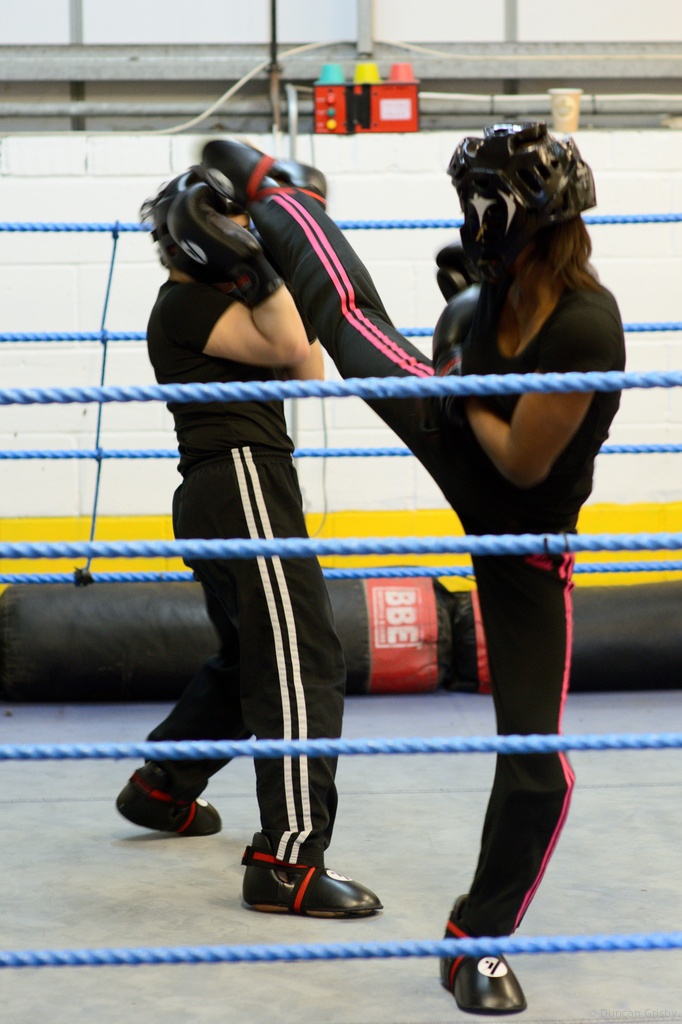
The Hook Kick can be defined as a niche technique because of the very restricted target area it can hit (face and head) and because of the fairly high level of flexibility required to execute it. In short, using a very British expression, it’s not everybody’s cup of tea. However it’s fantastic technique that, being highly choreographic, it helped several famous actors like Bruce Lee, Chuck Norris and Jean Claude Van Damme as well as Bill Wallace using this technique as a strongly identifying point. The Hook Kick is a great technique when coming from the leading leg, particularly when alternated with side and round kicks (in a very Superfoot style). In my direct experience I always found the Hook Kick as an excellent technique to score with and, in some cases, knocking down the opponent. From a physiological point of view the hook uses a fairly small set of muscles; although it can build up some decent speed it cannot deliver the destroying power of some other kicks listed in this post. Having accepted that the Hook Kick applies just for high level targets it usually requires a good preparation to be used effectively. The Hook Kick can be used both in offensive and defensive strategies anticipated by other techniques like punches or other kicks; defensive strategies using hook kicks require dead spot on timing. Unless you have suicidal aims I would not suggest to even think about using a Hook Kick in a self defence situation as it requires flexibility and super speed; also it exposes your groin to the opponent putting you in a very vulnerable position. As I mentioned several times the Hook Kick hits high and fast so it requires very flexible hips and legs and highly trained body to be used effectively. It is probably the least accessible kick mentioned in this post. Here a little video about performing the Hook Kick with the front leg:
Axe Kick
The Axe Kick is a niche kick both for the fitness required to perform it and for the quite restricted range of schools that teach it. I was surprised about how many people with years of experience in martial arts who joined my kickboxing club and had never seen an Axe Kick before. The Axe Kick is a very choreographic technique that hits the head of the opponent following a downward movement. The Axe Kick can be used both in offensive and defensive strategies combined with other techniques like punches and other kicks. The Axe Kick uses similar set of muscles as the Hook Kick although has less stringent requirements on the flexibility at hip level; also has it has a descending trajectory when striking it can exploit gravity as extra force to be added to the total result. Following a similar reasoning as previously used for the Hook Kick I would discourage anybody to use Axe Kicks for self defence although I am aware of people that managed that literally destroyed street attackers by using this technique. Being a kick that aims the face and head the Axe Kick is a technique that offers limited accessibility to people that are not particularly flexible. The good news is that, in my experience of teaching kickboxing for many years, Axe Kick becomes possible with some serious commitment and training while the Hook Kick remains the most exclusive one. Here a little video about performing the Axe Kick with the front leg:
Spinning Back Side Kick
If I had to choose of just using one spinning back technique the Spinning Back Side Kick would the one. The Spinning Back Side Kick has the unique advantage of combining rotation and straight movement in a single technique that also involves some of the biggest and most powerful muscles in our body; in short it is a killer kick. It can be delivered within a very short space (e.g. at the end of short range punches such as hooks and uppercuts) as well as from a long distance, bridging a broad gap. Although it can be used as a first technique to catch the opponent with a surprise element I usually combine together different kicks and punches and use the Spinning Back Side Kick as a terminating technique. However choreographic and somewhat flamboyant the Spinning Back Side Kick can be used in self defence situations as it will mostly catch the opponent by surprise; in these cases it should be delivered to the lower part of the body, from the groin and below. However the Spinning Back Side Kick requires practice and reasonable level of co-ordination it can be usually taught to inexperienced people of various levels of fitness and flexibility.