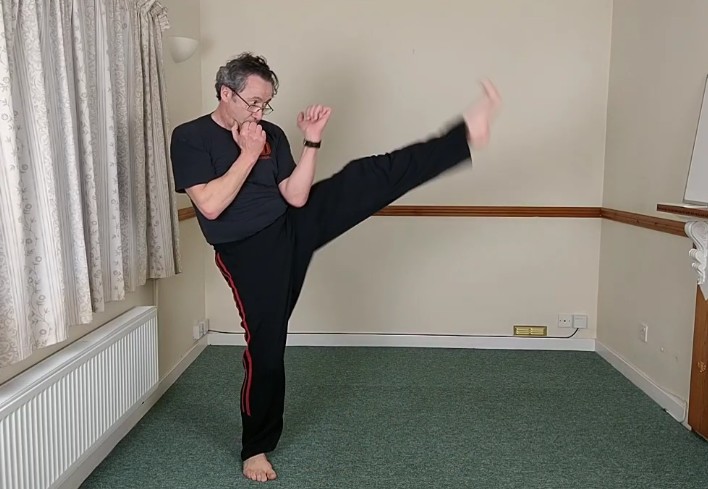
Stretching for kicks#2

High kicks have an arguable use in self defence although they display excellent athletic performance and look great.  In combat sports, particularly in full contact ones, many people have adopted techniques that limit kicks level to the waist and below.

Bill “superfoot” Wallace retired in the early eighties as undefeated world champion in the middle weight of full contact kickboxing: his combat strategy was always based on fantastic kicking techniques that often caught by surprise his opponents and knock them KO.  Wallace was not just good and superfast in kicking but he could shoot double of triple kicks with a single leg, using these techniques in the same way most boxers faint punching techniques.

In this video he shows some stretching for kicks, one of his legendary training exercises to help improving the central split particularly useful for round, side and hook kick.  Please enjoy the view and leave a comment:

Posted under fitness, video_review

Written by massimo on 15 May 2009

Tags: , ,

Which stretches will help me improve flexibility for kickboxing?

I was recently awarded best answer in Yahoo! Answers by replying to the following question:

Ive recently taken up kickboxing and my kicks lack power mainly due to lack of flexibility. Could anyone give me a stretching plan which i can fit into 10 minutes of the day? Thanks alot!

and here was my answer:

In order to offer a more accurate answer it would be useful to know what kicks lack of power due to flexibility. In any case it’s relatively difficult to explain what exactly doing as it would be necessary the assistance of an instructor that understand what you are trying to do.

Leg flexibility can be improved by consistent repetitive stretching and relaxation exercises that can be done both from standing and from a sitting position. These exercises will help most kicks, and in particular the ones that do not require to open your hips (like front kick, axe, crescent kicks). Splitting your legs and working out the hips and internal abductors will help your side, round and hook kick.
Your approach is right, 10 minutes extra per day will do a great deal if you are consistent. The most important thing is trying to relax your muscles when stretching, release every tension and breath slowly: treat your muscles well and they do the same to you.

Posted under fitness, theory, yahoo_answers

Written by massimo on 7 Oct 2008

Tags: , ,

The Importance of Proper Warm Up

I am convinced that a proper warm up is an essential part of any martial art session: I see around many clubs that are quite informal about this part of training and they resolve the issue by telling students to “warm up”. People therefore chat away for 10-20 minutes while performing mild exercises that don’t really challenge any muscle and then they start training.

In the best cases these clubs are training people that are not fully ready for the next part of the class: some times this causes injuries and permanent damages and it is a good reason for putting many novices off martial arts training.

The purpose of warming up is to put body and mind in the best state to handle the rest of the training. The exercises done during warming up should improve both power as the source of speed and flexibility to reduce resistance resulting in agility and ease of movement.

As different martial arts express themselves in completely different ways it might be tricky to state what a proper warm up should be like.  Let’s then try to define what activities might be suggested according to the group of muscles used:

  1. Punching, particularly if at full contact against bags, pads and focusing mitts, requires proper conditioning of knuckles, wrists, elbows, shoulders and pectorals: press-ups or push-ups of various kind, with hands positioned at various angles can be a good way of warming up and conditioning that area.
  2. In martial arts that use medium and high kicks people should pay serious attention to their legs’ flexibility performing a variety of stretching exercises than involve flexibility of the rear part of the legs, the internal adductors and the groin area.
  3. Throwing techniques require good core training that is also of great support to punches and kicks.  Recent physiology studies have demonstrated that the core area (torso, abdomen and part of the back) is responsible for delivering power in most movements.  The power that most traditional martial arts define as coming from the hips is in reality delivered by the core.
  4. The abdominal area is a very important part of the body. Abdominal muscles are the only protection against strikes for delicate organs like stomach and liver: there are no bones here like in the chest so a number of different abdominal exercises like sit-ups of various kinds should be performed on a regular basis.
  5. The whole spine is subject to a number of snapping and twisting movements following punches, kicks and throws: warm up and strengthening the back ensures no long term back injuries.

An average warm up should last between 15 to 45 minutes, taking into account the following criteria:

  • age of the students: younger pupils need shorter warm up than people in their forties or above;
  • the martial art practiced: Tai Chi can be a warm up in itself while Judo or Thai Boxing need very specific exercises;
  • students’ proficiency: beginners might have a progressive approach to warm up while professionals need a long and well structured one.

In my experience warming up is an integral part of martial arts practice and should occupy a significant portion of each class rather than being an optional activity.  Benefits are out of question and ensure safe and healthy practice to people that want to see martial arts training as part of their life for the long term.

Posted under educational, fitness, teaching, theory

Written by massimo on 6 Oct 2008

Tags: , , ,

CARISMA Summer Camp 2008

Get a bunch of great people, passionate about martial arts, put them in a pleasant location of Hungarian country side and get them to train martial arts for 14 hours over a period of 5 days, in temperatures ranging between 27 and 38 degrees Celsius. Blend in some great activities like see sighting, wine tasting and eating most meals in a good restaurant and, no doubt, you get a successful summer camp.

The CARISMA Summer Camp 2008 was the fourth on a row that we organized: main purpose of the camp is having a great holiday in an unusual location and at the same time enjoy an important amount of highly focussed training hours. This allows all participants to learn new things, train, practice and correct mistakes about their own techniques. All sessions were outdoor, on grass, in the shade offered by a couple of large oak trees.

Day 1 – Thursday – Cambridge to Csokonyavisonta

Soon after their arrival all participants were allocated to their accommodations: within half an hour the first session started, at 5:30PM. Following a light warm up we started combinations of punches and kicks. Knowing that everybody was up early, had a long trip and was acclimatized to temperatures in the teens or low twenty of this year’s dreadful British summer there was little point in pushing this session into power work, given the afternoon’s temperature in the high thirties.

The underlying principle of this session was to be light and fluid trying to extent accurately all limbs while using proper guard and footwork. Next part of the session was about coaching each other, again to work on footwork and proper guard with the coach calling combinations of punches from the attacker. Followed about half hour of light, half speed sparring: as we were an odd number there was a person that at each session had to spar against two people at once, just to make it more interesting.

We concluded with a few exercises of tai chi – chi kung just to cool down and relax. Dinner at the local Korona Etterem (restaurant) and an early sleep was due. Meeting arranged for the following day at 9AM, ready to start.

Day 2 – Friday

While warming up I checked with the various participants what topic they were mostly interested in covering during the next 4 session, lasting 3 hours each. Here is the list of topics to focus on:

  • Multicombat (4)
  • Basics about round kicks (4)
  • Endurance (1)
  • Jumping kicks (1)
  • Mix, including Wing Chun and Tai Chi (3)
  • Various Techniques with detailed explanation (3)
  • Footwork (2)
  • Sparring (3)
  • Sparring two vs. one (1)

Having a total of four instructors, 3 black and one brown belt, in a group of eleven people surely added great value to the whole camp and lower belt truly appreciated the level of attention they received at all time.

The Friday session covered the following topics, more or less in this order: Round kick clinic: we explained and demonstrated all little details about performing a correct round kick, putting emphasis on the footwork, how to open correctly the hips and coordinating the whole movement together. While we opened this topic we moved over to side and hook kicks that share a good part of the principles with round kick and are usually causing the same problems to people that do not perform well on round kicks. Foot work practice: one person coaching the other, stepping back and forth at different distances every time ensuring that the attacker positions him/herself at the right point before striking jabs and crosses. The second half of this exercise was about pivoting around a central point, alternating the coach or the attacker in the centre, while performing hook punching techniques. Sliding kicks: we practiced various combinations involving sliding round, side and hook kick, and various punches. We finished by cooling down.

For the afternoon and evening we agreed to prepare, cook and eat a traditional goulash, so after visiting the nearby town Barcs and buying all we needed we went to one of the houses were the participants were staying. While a few people started to prepare a cold lunch based on bread, cured meats, cheese and fresh vegetables the others started cutting and chopping the various ingredients: the cooking of the goulash, in a traditional cauldron over the open fire, started at around 4:30PM. The cooking time, in excess of 5 hours was to be spent relaxing, having a drink and with Adam playing his guitar. The result managed to exceed expectations

Day 3 – Saturday

Luckily it rained overnight and it was a bit overcastted: temperature dropped in the low twenties making this session much easier than the previous day.

We started an exercise that both improves guard and foot work: one person attacking with jabs and the other replying with hook punches. We continued with combinations involving sliding kicks and punches. We did then rounds when one person was coaching the other, calling for punches combinations (2 round each person), kicks combinations (2 rounds each) and combinations of punches and kicks (2 rounds each). We finally practiced, from a kick boxer point of view, defending against a chain punching attack as practiced by wing chun practitioners. We finally cooled down.

We spent the rest of the day visiting Pécs a nearby town. During the afternoon we were sightseeing the city centre and then we had dinner in a nice restaurant.

Day 4 – Sunday

After warming up the session started with jab-cross, duck to avoid hook counter attack and jab-cross again. The remaining part of the class included: circular foot work by punching hook punch with both hands while either the coach was pivoting around a central point and getting the attacker to turn around or the coach was turning around forcing the attacker to pivot on a single point. We then practiced free combinations, alternating, of low contact kicks and punches. Combinations of punches and kicks always involving spinning back kicks. Sparring sessions, both semi and light contact. The remaining part of the class was involving simple win chun drills while 3 people in turn were sparring 2 vs. 1.

The rest of the day was spent visiting Badacsony, a winery hill north of lake Balaton: we first had some fine wine tasting from the local wine makers and then had dinner in a nice restaurant with a great panoramic terrace overlooking the lake.

Day 5 – Monday

Being the last day we decided to have an easy day (after training, the session was as hard as the others). Training was organized at the Barcs spa complex with the intention to spend there a good part of the day.

The session included: semi contact sparring, light contact boxing sparring against a wall top ensure no foot work and improve mobility of the torso, combinations of Multicombat that included knee and elbow strikes and some very basic wing chun drills.

At the end of the session, while cooling down we asked people how they felt about the overall camp and what we could have done more or better. While general consent was to be happy overall some of the answers included suggestion for next year:

  • Longer staying, allowing 6 or 7 days of training instead of 5;
  • Possibility of adding 1-2 extra afternoon sessions that might include meditation, yoga, visualization or very basic tai chi practice;
  • More sparring.

The rest of the day was spent chilling out in the spa complex, swimming in the pools, and enjoying the sauna and the large Jacuzzi. Dinner in the local Korona restaurant was the followed by a little get together with a few drinks to celebrate Josh’s birthday.

Day 6 – Sunday – Csokonyavisonta to Cambridge

There was no training on this day as everybody had to get back to Cambridge.

Partecipant to the summer camp were: Adam, Andrea, Chris, Duncan, Hayley, Heley, Josh, Massimo, Robin, Si and Wez. Pictures courtesy and Copyright © Duncan Grisby.

Posted under events, fitness, self defence, styles, teaching