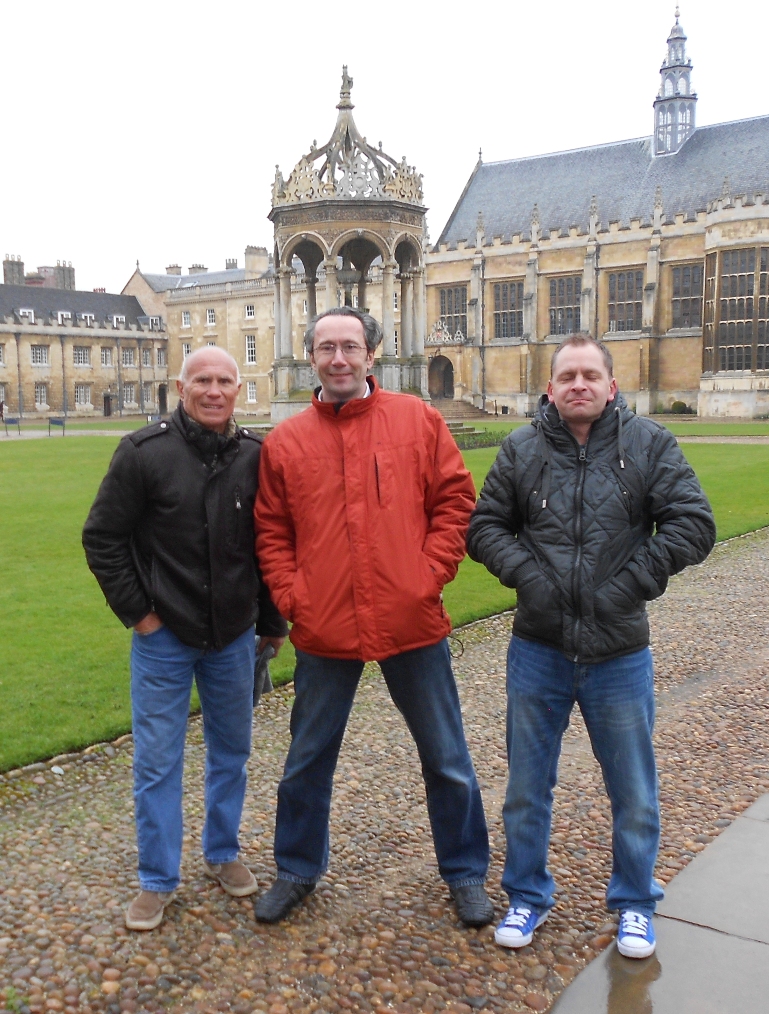
Meet Bill Wallace: training with Superfoot

I wrote about Bill Wallace in the past and I explained about his amazing style built on very fast techniques and combinations always developed from the left side stance.  Given his strong knowledge about the human anatomy, built on a master in Kinesiology, he developed over the many years of his amazing career the so called “Superfoot” system that first helps to develop flexibility on the main groups of muscles involved in kicks and then teaches how to use, in a very effective way, the three kicks and the couple of punches on which he bases his system.

Earlier today I had the opportunity of finally meet one of my heroes in martial arts: Bill “Superfoot” Wallace was running a morning seminar organised by Colin Payne from TKO in Chatham (Kent, UK); although I found out about it just a few days before, I dropped all of my engagements and simply went there J  Bill Wallace was famous when I started Kickboxing in 1981 and I never had the opportunity of meeting him so this was a chance not to be missed.

At first impression Superfoot appears as very friendly and unassuming person: he arrived with a big smile and looking to “have some fun”.   Within minutes from his arrival we started with some warm up techniques, very similar to some I have seen on his DVDs and we worked out flexibility for both the hamstrings and internal adductors in order to help relaxing the muscles needed for the 3 main kicks that make up the Superfoot method:

  • Round kick
  • Side kick
  • Hook kick

Then we started some simple exercises to improve speed and coordination about delivering individual kicks from the above list; finally we worked at combinations that use either a punch (typically a jab or back fist) or one of these kicks as a preparation for another kick.

His philosophy was and is conceptually simple: keep hitting with one technique that works and hurts a bit and keep changing angle.  Although the repertoire is quite limited it just works.  It is about working on speed, surprising the opponent with techniques that will probably not knock him down straight away but will upset him many times, make him nervous and help building up for the eventual final strike while scoring many and many points in the process.

At 65 Mr Wallace is no longer a young man: from his face you could compare him to other men of similar age.  Looking just at his body most people will think he is at least 20 years younger and that is until he starts moving.  That’s when you think he could be 25 or 30 years younger.  He can stretch his legs more than the majority of kick boxers and other martial artists I know of.  When he was a professional fighter his kicks were of truly lightening speed but even now he can kick amazingly fast.  There were several under 30 at this seminar that could not do what he was demonstrating at the speed he was doing it.

Is he a super human (apart from the Superfoot)? Absolutely not! He simply (!) managed to improve his techniques to perfection and then he adds to his techniques an amazing knowledge of what works, what scores, what helps you winning.  Full contact kickboxing is today dominated by a number of good boxers that work out how to put a few round and front kicks within a rich combination of punches.  His technique and style is unique and I don’t know of any professional full contact fighter that could fight today in this style but still he can be described with similar words I heard by a TV commentator during one of his fights: “you know he will come from a left side stance and you know he will either kick side, round or hook kick; nonetheless he scores and he does it every time”.

Meeting Bill Wallace was an amazing experience and although the workshop was less than three hours long I took home a list of amazing tricks that I will surely add to my repertoire and I will start teaching straight away.  Thanks Superfoot, looking forward to seeing you again.

Posted under celebrities, events, styles

Written by massimo on 1 May 2011

Tags: , ,

The Way of the Dragon – Bruce Lee

Copyright to its original ownerAlthough I must have seen this movie tens of times every time I find it on TV I tend to watch at least a few scenes: last week was no different.

I have a great respect for Bruce Lee and what he managed to do during the few years of his intense career as martial artist first and then as an actor.  At the same time I have to say that I started noticing too many flaws in the plot, coreography and, actually, even in the fighting scenes of most of his movies.

As usual there are a few things that are generally contraddicting the whole story: the character played by Bruce Lee is sent to Rome where his cousins have a Chinese restaurant and they are having trouble with a local gang that, by the way, with all place in the Italian capital really need that restaurant to be the centre for an international drug traffic :-)

Bruce is depicted as a Kung Fu champion, Chinese boxing as they define it many times: so the first question is why in one of the first fighting scenes against the gangsters he pulls out 2 nunchakus, a Japanese (Okinawan to be precise) weapon?

The whole movie has a very broken rithm (like Bruce Lee suggest to use when fighting) and it culminates in the final scene, the very famous one where Bruce Lee defeats Chuck Norris (the American Champion) in the Coliseum (see the clip below.

According to the movie “The Warrior Journey” Lee explains that this scene starts with him fighting Norris using traditional Kung Fu (I would be curious to know which style considering that Bruce Lee had a Wing Chun background with no high kicks while here most kicks are toward the face…) and is loosing.  So he changes strategy in the second part of the scene and using the basic principles of Jeet Kune Do he becomes adaptable (and kicking the legs) and manages to kill his opponent.  I mention this scene often as an example for a particular style of spinning back hook kick that Chuck Norris uses several times when I explain one of the common mistakes people can make when performing a hook kick.

I am going to conclude this by stating that for a Chinese production of 1972 this movie is great and there is no doubt that next time I will  find it on TV I’ll watch it again.  At the same time I fail to get as excited and inspired as I used to: perhaps I have seen live so many performances of good martial artist that Bruce Lee is no longer so special and unique?

I’ll let you judge what I am saying after you see the clip below:

Posted under celebrities, movies, video_review

Written by massimo on 12 Nov 2010

Tags: ,

Kickboxer – Van Damme

Copyright of its author, all rights reservedLast night I was browsing various TV channels and I bumped into Kickboxer a movie produced in 1989 with the main character played by a young and f it Jean Claude Van Damme.  I remember seeing this movie at the cinema when it was released (yes, I am that old) and I often refer to it when I explain certain techniques, not necessarily for the quality of the scenes but mostly to describe how things should not be done.

The story is pretty simple: Van Damme’s older brother (in the movie) is an undefeated national champion of full contact kickboxing and somebody suggests he should go and change the Thai champion.  He goes and accepts to fight Thai Boxing rules (that obviously allow elbow and knee strikes that he cannot handle) and he gets not only defeated but his back gets broken and has to be on a wheel chair.  Van Damme’s character decides to avenge his brother by learning kickboxing under a famous local master and at end, as it happens in any respectable American production the good wins, the bad gets beaten and humiliated and so on…

My reason to write this post is to point out a few features that suggest watching the movie while a few comments about how the director could have done a better job.

Van Damme has a typical Karate posture and style, with a low (shall I say inexistent?) guard and a very pumped up attitude for single killer punches  rather than good, classical combinations of boxing techniques: he doesn’t (at least in this movie) looks very much of a kickboxer.  At the same time his fitness and technique, at least in performing certain kicks (like at the end of the fight when, out of the ring kicks Tong Po in the face with a perfect side kick and then, with the same leg he kicks round kick in the face of the organiser) is just great.  What is very annoying is the continuous cut and re sampling of scenes that try to amplify the prowess of the various techniques.

In movies people can be kicked and punched for hours without much damage or even running out of breath and this is no different but, ok, perhaps I am a bit too strict on these things.

As a conclusion I can say that this is a decent martial arts movie, if you ignore the awful non combat scenes and plot it shows some good techniques and, as it happened last night, when I bump into it I tend to watch at least some parts of it.

Posted under celebrities, movies

Written by massimo on 23 Oct 2010

Tags: , , , ,

Free Ebook from Martial What?

Bruce Lee is the greatest martial arts actor of the 20th century and he is considered by many, including myself, a great martial artist that gave an enormous contribution to the development and diffusion of martial arts. Good news is that for all subscribers by Email of this blog we are offering a free Ebook download, titled “Bruce Lee’s Strength Training”, that contains a tips of training put together by one of the original Bruce Lee’s students.

Bruce Lee's Strength Training

Bruce Lee's Strength Training

In order to download this great Ebook please click on this link and insert the password you will receive from our latest post via Email. Please subscribe to Martial What? by Email Now! in order to receive the password with the next post.

Posted under blogging, book_review, celebrities

Written by massimo on 9 Mar 2009

Tags:

The role of kicks in professional fights

I recently found this video (see at the bottom of the post) on YouTube and I was impressed simply because it’s rare to see somebody using his legs in such an efficient, powerful and effective way.
When I started karate and kick boxing, in the early eighties, it was noticeable a strong predominance in kicking techniques.  At that time people like Bill Wallace and Dominique Valera were dominating tournaments worldwide and most people entering competitions felt they had to be great kickers.  I remember my master going to seminars run by these legends of kick boxing and coming back with more and more tricks about strategies and combinations of kicks to be used in training and competitions.

Then, within a few years, a new generation of kick boxers started to populate the world.  These new people were not excellent kickers, not very flexible in the lower part of their body, so they started to develop techniques and strategies to use a minimum amount of kicks in any given fights while using more and more boxing techniques.

By definition a kick is a powerful technique: it delivers a lot more power and damage then a punch but it also uses a lot more energy and it’s usually slower.  These simple rules changed completely the trends in full contact and professional fights: in the last few years you can see all fights being dominated by good punching, a few round and front kicks and literally no much else.  In K1 or in MMA people tend to punch, kick and knee in the former or, often, looking for the grappling in the latter.

Nonetheless it’s nice to see that occasionally a good kicker enters the professional arena and when that happens he/she usually dominates for a some time, at least until a better kicker comes out or somebody studies very carefully how to avoid being kicked and defeat the kicker by using different techniques.

Posted under celebrities, styles, teaching, video_review

Written by massimo on 12 Oct 2008

Tags: , , , , ,