
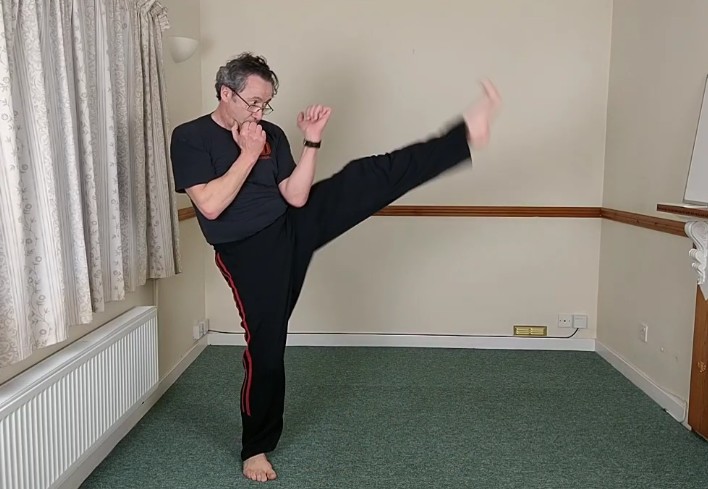
Regular training to avoid injuries

There are lots of people out there that play the occasional football or tennis match or spend a week per year skiing.  Most martial arts require a different approach and cannot be practiced occasionally if you want to enjoy the benefits that they can bring and avoid injuries.  While I adopted a regular, quasi religious training regime since I was a teen ager I see many of my students or other fellow martial artists having a very irregular training regime: I believe this can be the strongest cause of injuries and loss of motivation.

When you are at the beginning of your training you have a steady increase of performance in terms of speed, power, flexibility and, progressively, technique.  Your mind, as well as your muscles, get trained and they learn the subtle intricacies of how and when firing the right muscles in the appropriate time and order.  You can consider that some of the muscles used in certain techniques are not used much in our normal daily activities.  For the same reason these muscles have a stronger tendency to loose their performance when not used.

While in regular training you enjoy progresses in your training and this enjoyment is released in the form of endorphins that make you feel good.  If, for any reason, you stop training for a few days or weeks your muscles tend to loose some of their fitness.  When you try a technique that was nice and easy last time you did it you find yourself suddenly struggling with it or, if that happens in a self defence situation, risk your life in the process.

A regular practice for amateurs should be considered when training 2-3 sessions per week, possibly practicing all year round: each training session should be between 1 and 2 hours long.

Regular training to avoid injuries

Posted under educational

Written by massimo on 28 May 2010

Tags: , , ,

Meet Maul Mornie

After having seen the numerous videos that Maul has on his You Tube channel I was convinced I had to meet him and try out his style. I was initially discouraged by the fact that he is always travelling to different places delivering seminars and that he is usually booked for a good part of a year in advance but, nearly by mistake I found out he was in touch with a local teacher of Silat that runs classes in Cambridge University, Lee Wilson, and so I caught the opportunity and turn up at a seminar held in Darwin College in early March.

Silat Suffian Bela Diri is a martial art that originates in Brunei and I believe it is somehow related to other Silat styles that are practiced in Indonesia and Malaysia: Maul himself admits to have little knowledge of those other styles and that what he practices and teaches is a direct lineage from his family.

The first impression of meeting Maul is warm and friendly: he appeared in the training hall greeting in a very friendly way people he met in previous occasions and welcoming in a equally warm way myself and others he was meeting for the first time.  His smile and facial expression is very reassuring and encouraging as well as his teaching style that is involving from the very first second.

Silat, similarly to other martial arts of South East Asia, is a martial art based on weapons, particularly knife: the training is usually starting by learning how to handle and defend against a weapon and moving onto bare hand fighting at a later stage.  As the seminar was open to all levels and there were people that, like me, had very little weapon experience he decided to start with the very basic drills that included the three basic knife strikes (cutting down vertically to the head, cutting across slashing the throat and stabbing horizontally toward the stomach).  Within minutes we were all practicing these basic drills and developed amazing ways of dealing with these kinds of attacks that would potentially be deadly if applied by an opponent with a live blade (all training is practiced with training knife blunt blades and edges).

The most amazing thing was seeing how Maul could handle these attacks with amazing precision and all counter attacks where at the same time conceptually simple and amazingly effective within a broad range of situations and circumstances.  The other hard to believe feature is his skill of moving incredibly slowly to demonstrate a technique that could potentially harm the opponent but then accelerating at an unexpected (even for a trained, expert martial artist) speed when showing how a techniques should be delivered in real life.

I was really amazed and totally impressed by Maul as a top martial artist and teacher as well as by his great personality and friendly manners: if you have a chance attending one of his seminars just go and try his style, technique and his unique teaching skills.

Posted under events, styles

Written by massimo on 29 Mar 2010

Tags: , , ,

The Martial Artist of the 21st century

Martial arts were developed to help people fighting, being it for attacking people in battle or for defensive purposes.  If we consider China and Japan, two countries that gave birth to some of the most famous martial arts in the world, they have profound differences in the way martial arts developed over time.  In the former martial arts initially developed from the Shaolin temple and from the Taoists masters that among other things were teaching martial arts, being also experts of medicine, calligraphy and philosophy.  In Japan the martial arts tradition was more based around the training of Samurais and the more military orientation of Japanese martial arts is still very visible when practicing traditional martial arts from this country.

Practicing martial arts in those ancient times was very much a way of life and it often started in very young age, during childhood, continuing for the whole life of the individual that would eventually start his/her own school and move on, maintaining the so called lineage. Fast forward to the 21st century (and good part of the late 20th) and things have taken a completely different perspective, particularly when the same martial arts are now taught in countries where the culture and tradition on which they were originally based is simply not there.  Many styles have somehow evolved while new others have been defined to adapt to the culture or habits of the people where these are practiced.

Being a martial artist today in the western world is challenging because of all interferences caused by our modern and stressful lives.  Most of us need jobs to live and maintain an expected standard of living and although there are a number of “professional”, full time, martial artist I would assume that the majority of martial artist have a full time job and practice martial arts for self defence, fitness, health, fun, self improvement or any other suitable reason in their spare time.

I would like to define here my concept of an ideal profile for a person intending to practice martial arts and what he/she should aim to become in the long term.  A martial artist is a person that should be:

  • training regularly: often this requires to organize your own life around training rather than the other way round.  Regular training helps absorbing even the smallest subtleties of the style and master them appropriately;
  • performing all techniques pertinent to his/her style in a variety of different ways. E.g. demonstrating a strike or a throw at a very slow speed to help a beginner to understand all its subtleties or at maximum speed to show its full, devastating, potential;
  • understanding why each technique in his/her style are performed in a certain way and the bio-mechanical and physiological implications for it;
  • comparing and sharing his/her knowledge with people of the same style or from different styles in order to always enriching his/her personal knowledge of martial arts;
  • having a knowledge of what other martial arts do and what are their weapons and having an objective view of their pros and cons;
  • knowing at least the basic steps of development and history of his/her martial art;

In short a martial artist should be actively collecting and learning techniques and combinations of a given style and applying his/her own interpretation of them.  The knowledge of the background of other styles may well influence the final result.

Posted under educational, theory

Written by massimo on 19 Nov 2009

Tags: , ,

Meet Benno Westra

I was recently guest at a Wing Chun seminar run by sifu Benno Westra organized by my friends at Cambridge Kung Fu.  Wing Chun is a martial art originated in the South of China and it’s predominantly an bare handed based system that was initially defined by a woman: advanced forms use butterfly knives and long pole but the majority of applications and demonstration are done empty handed.  Wing Chun is a martial arts that to my knowledge has no sport application and it is taught primarily as a simple, direct and no frills self defence system.

Wing Chun is in reality a family of different styles and I personally trained many different ones: it is intriguing to see how each of them is similar more or less to the others while it interprets various aspects in a totally different way.  In general emphasis on one or the other technique is due to the lineage, the master or grand master that defined the style and his/her personal taste for one or the other aspect.

The first impression of seeing and meeting Benno Westra is warm, friendly and encouraging: a big step forward compared to many high ranked people in the Wing Chun arena that like to look down to the common mortals and use intimidation and nearly mystification to justify their position.  His practical approach to Wing Chun is meant to enable any practitioner to have a good structure and a no non-sense preparation to situations that can happen on the street.

Given my exposure and years of training in other styles of Wing Chun I was some times performing instinctively in a way that was substantially different from what being practiced.  When he corrected some of my techniques he was explaining and justifying why in his style things work that way.  I appreciated hearing a number of times how there isn’t a right or wrong approach to one or the other situations: that leaves a great level of freedom to analyse and appreciate what works and what doesn’t for yourself.

Starting from a simple drill that was deflecting punches to the face we built in a number different variations of lat sau, using wu sau as a central, main technique for the day.

It’s difficult to measure results out of a 4 hours seminar, because it depends very much on what you expect to get out of it.  My approach is usually to go with the flow, experience and see what comes out, trying to be totally unbiased, objective and to learn something: I was happy to exceed my expectations in this occasion.

I liked Sifu Benno’s style of teaching: he uses many interesting metaphors and humorous stories and jokes while presenting top quality techniques and offering comparison to many other martial arts of which he has practical experience himself.  I am looking forward to the possibility of participating to another seminar.

Posted under events, styles

Written by massimo on 1 Apr 2009

Tags: , , ,

10 reasons why martial art are an effective alternative to gym, aerobic and lifting weights

Although martial arts are not team activities there are many elements of cohesion that motivate martial arts practice more that any other sport. Let analyse why this is true:

  1. Practicing a martial art is a long time investment in your health and well being: the time to proficiency is often long enough to establish good habits in your life, those that last for a long time. If and when you stop training for a while you’ll miss it, both physically, mentally and emotionally.
  2. Most martial arts teach a broad variety of techniques that keep you busy for many years just to master them all. In this you see a natural progression and having continuously new things to learn it makes it very interesting. Many masters state that perfection can be aimed but never achieved, therefore even after many years of training you are running after perfection while you keep adapting your knowledge and techniques to you ageing body.
  3. As are you naturally going to meet people that are better than you it will be natural to have a sense of challenge to improve day after day, session after session. In general the progression is easy to monitor and to measure therefore it is relatively easy to compare results against effort.
  4. The achievement of a certain level of proficiency, lesson after lesson will release endorphins that naturally make you feel good. At the end of each training session, with the natural tiredness you’ll have a feeling of well being that is quite addictive.
  5. Although martial arts manifest in many different ways and levels of intensity the overall training will ensure the practitioner to be a well round, balanced athlete with a decent level of fitness, stamina, strength, flexibility and coordination.
  6. Although martial arts are usually practiced in pairs and groups, some of the training can be rehearsed solo: that allows the practitioner to keep training, at least on some of the exercises, when she is on her own.
  7. Martial arts practice involves a reasonably complete workout rather than concentrating on a single part of the body. Different styles will put more emphasis on different areas of the body while practicing a balanced mix of exercises.
  8. Martial arts are a great stress relief: the aggression accumulated during work or while at school can be easily channelled and released in a controlled manner toward the practice of your techniques. It’s likely that after training the amount of aggression you had before starting is reduced or completely gone and you feel calmer and more in control.
  9. Martial arts training ensures that your whole attention will be directed toward your training, with minimal distraction. Even when your feel at an adequate level of proficiency and most moves come naturally without the need of thinking too carefully, your partner / opponent is there to punch you, to kick you or to throw you. Self preservation will naturally motivates you to put full attention in what you are doing.
  10. The sense of challenge and cooperation that can be found in many martial arts club I have experienced can foster friendship and social entertainment outside the training hall (dojo, kwon, dojang…).

Posted under educational, fitness

Written by admin on 28 Feb 2008

Tags: , , , , , , , , ,