
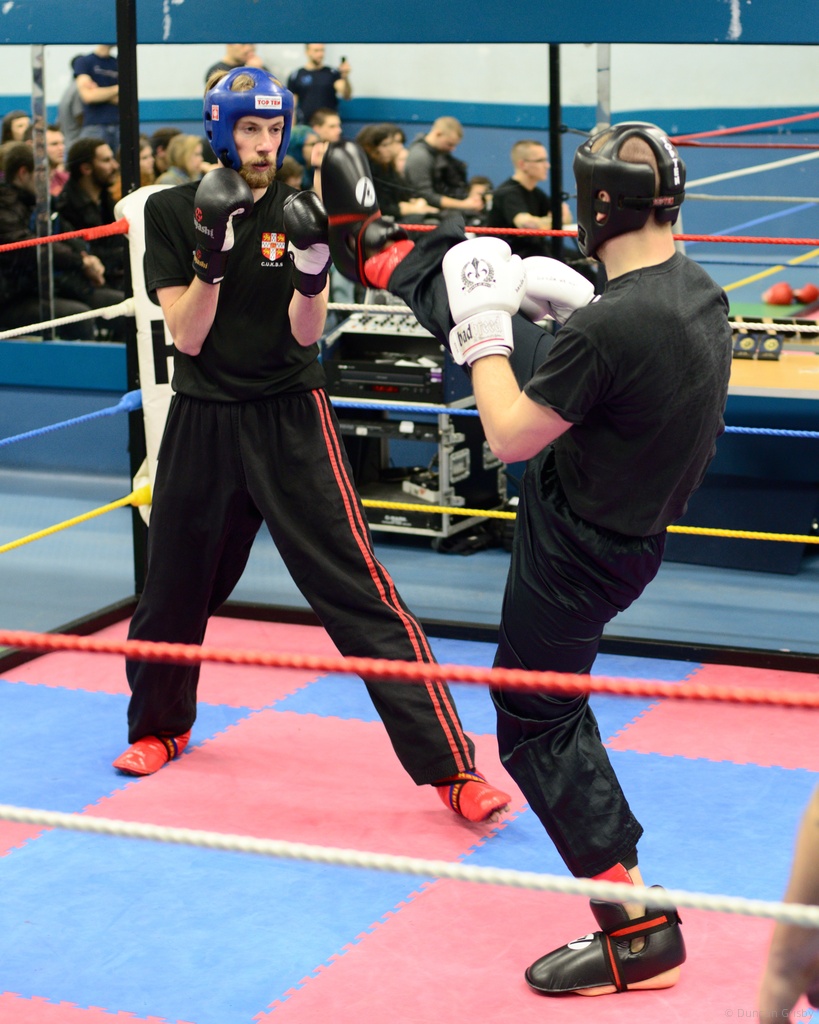
The dilemma between technique and toughness in fighting sports

We define combat sport a sport application or expression of a martial art where we set and impose rules to limit and control the amount of damage that can be inflicted to the opponent.

Ranging from contactless Karate tournament, via Boxing and all the way to MMA fighting sports usually assign points to each technique that scores and in many cases contemplate the eventuality of one of the opponent being knocked out (KO) or giving up the fight before the end and accepting defeat.

I am a strong fan of good technique and properly applied guard at all times: high quality technique will be more efficient in terms of using your energy as well as minimising your change of running out of it.  The guard, as I previously wrote about, will ensure you won’t be hit as often or as hard, reducing the chances for a KO from your opponent as well as minimising the points scored on you.  Most people I am teaching to are buying into this concept and accept that good technique must be there as a foundation to build on the remaining attributes of a winner.  A minority of others, being naturally aggressive and perhaps with a higher pain threshold, they assume they can just get in the ring let the opponent coming forward and aiming at knocking them down before the end of the fight.

From my point of view this is a strategy that is meant to be short lived and not guaranteeing a long career for a winner.  Here are my reasons for it:

  • Knocking somebody down, in a fight where both opponent are well trained and fit sports fighter is a small chance of hitting the right spot at the right time: it doesn’t happen often, particularly if your opponent has proper technique and guard;
  • Regardless how tough you are is just going to be time before you meet somebody tougher, somebody who has higher pain threshold, more adrenaline in their body and don’t go down as you expect;
  • If you are just aiming at the KO strike without a point based strategy two things can happen: you don’t succeed at your KO and the opponent wins because scoring more points or you become victim of your own strategy and get hit hard where it really hurts and get knocked down yourself;
  • Repeated hard strikes in the head cause long term disabilities and injuries so even if it doesn’t hurt now it will cause problems later.

Muhammad Ali was the first boxer that demonstrated that a fight could be won by playing by the rules, not looking for a fast KO but keep scoring on the opponent throughout the fight.  That doesn’t mean being a lower quality fighter but simply someone who is there to win, repeatedly, aiming at the top title.  Another demonstration of what I am stating here was the recent boxing fight of David Haye v Nikolai Valuev: the quality of the show was somehow not there as it can be seen in these videos.  Haye kept moving backward and away from his massive opponent Valuev but as he kept scoring with many, many points at the body, he won the world title.  That was a very well managed fight played strategically from beginning to end with the victory in mind.

I would like to conclude with a simple clarification: good technique is not just meant to look good, it’s meant to be very powerful, fast efficient and effective for the person using it.  At the same time when training for sport fighting you should always bear in mind what the rules are and understanding how you can win by scoring more points.  If the KO is allowed in your discipline and you can finish the fight before it may be a bonus but a good fighter is more likely to win more often than a tough one.

Posted under styles, theory

Written by massimo on 12 Jan 2010

Tags: , , , , , ,

The role of forms in martial arts

I have just read this great post on Ikigaiway and started writing a comment: when it became too long I though it was a good idea to write my own post.

Most striking martial arts, being them bare handed like Karate, Wing Chun or Tae Kwon Do or weapon based like Iai Jitsu, Iai Do and Kobudo, use forms (Kata in Japanese) as a way or classifying various groups of techniques.  Forms are usually increasingly difficult and they can be part of grading.

Forms, in any martial art, is meant to be a way of collecting a number of techniques, arranged in logical sequences, with to 4 main purposes in mind:

  1. solo practice, to allow the practitioner to keep training without an opponent;
  2. having a kind of comparable scale among different practitioner at similar level;
  3. practicing and rehearsing logical sequences of techniques that eventually should be applied to real right
  4. collecting techniques that otherwise might be lost in teaching over various generations of students: let’s not forget that until a few decades ago video recording or filming was not as practical and affordable as it is today and a book has lots of limitation is showing dynamic 3D actions.

In the first video shown in Ikigaiway post the young lady moves a lot, she is very acrobatic but most of what she does is not useful, if not dangerous,  in a fight.  The second video is more realistic: question here is: “if you push somebody away with a powerful yoko geri (side kick) what it the probability that his face will be there to be hit with an elbow?”

I am convinced that a form is (supposed to be) a fight against imaginary opponents that the practitioner attacks or defends against.  Somebody practicing a form should always ask herself:

  • “what is this (particular technique) for?”
  • “would it really work?”
  • “what about if a real opponent appeared now in that position?”

If the answer to any of these question doesn’t make too much sense than what you are practicing is not a practical form and, while it can help working out fitness, balance and flexibility, it will not ultimately help your fighting skills.

Posted under styles, theory

Written by massimo on 6 Feb 2009

Tags: ,

My thoughts about Karate

I practiced Karate Shotokan for 2 years in the early eighties; I had a go at Wado Ryu in 1994 for less then a year and I then trained in many occasions with experts, dan level, of Goju Ryu, Shorin Ryu and Kyokushin kaikan.  I find it an interesting martial art(s) that brings, in most cases the whole Japanese (and Okinawan) tradition.

Description

I will generalise in this post Karate as a single martial art while I am aware and encourage the reader to find out the differences between the over 10 main styles that all share similar techniques but develop a variety of strategies and preferences for linear rather than circular movements, harder versus softer approach to attacks and blocks and so on.  Karate manifests itself with a broad variety of strikes using various parts of the hand, elbow, knee, and foot.  Hands can be used to strike with a closed fist to hit in a traditional punch with the knuckles, hammer fist or back fist; open hand can deliver the chop with the external edge, knife hand or poke with fingers, finishing with palm strikes.  A foot can hit with the ball in a front kick, the edge in a side kick and the hill in a rear kick.

A Karate class is usually regulated by a number of rituals like the initial salute, bowing toward the master and fellow students and kneeling in line while the master explains. The basic techniques, punches and kicks are usually taught first, together with the simpler stances and guards.  Other strikes and advanced stances and position come later, at higher ranks.

When training Karate practitioners become aware of the famous 3 K:

  • Kata, representing forms: they are sets of choreographed moves, to be practiced solo, simulating a fight against a number of opponents.
  • Kihon, representing technical training: when two people are practicing various techniques attacking and defending each other.
  • Kumite, representing fighting: when two opponents are facing each other and freely attack and defend each other in a competitive way. Rules about Kumite vary between styles: in some cases it’s bases on point sparring, with numerous limitations about areas that can be hit (e.g. no legs or back) while in other cases it’s free, full contact.

History

Karate (that in Japanese translates as empty hand, with the mean of fighting without a weapon) is a traditional martial art that originated during the 19th century in Okinawa when it was independent from the rest of Japan and it later spread across Japan.  While some influence of Chinese martial arts is found in the very early stages of its development the various styles of Karate developed independently in Japan and Okinawa.  Karate started to have a significant presence in the West after WWII and gained great popularity after the big wave of Hong Kong movies that were shown in cinema theatres in the early seventies.  The Kung Fu shown in most of these movies was similar enough, to untrained eyes, to stimulate and encourage many people to start learning and practicing Karate.

What I like about Karate

Karate, like many martial arts, teaches and improves coordination, body awareness, and increases fitness helping to delivery faster and powerful techniques.  With an average practice of 2-4 hours per week it keeps the practitioner in good shape and it can avoid the need for gym or other sport activities.  The continuous training helps to ensure a good harmony between mind and body that can be utilized outside the Dojo (the venue where a Japanese martial art is practiced).  Karate teaches essentially 3 good things:

  • How to have snapping, explosive, techniques that can hit at the required and wanted level of power.
  • Great control of one’s body at speed: you learn to have good coordination and how to hold your body in very precise positions.
  • Devotion and respect for the master and fellow students: it instils discipline and rigour in practice and in life.

What I don’t like about Karate

In my experience Karate has 4 main limitations:

  • The basic concept of guard is very open, offering a large percentage of the practitioner body a face available to the opponent’s attacks.
  • Most karate styles rely on very strong, decisive, strikes assuming that a single kick or punch will stop the opponent.  Bad news starts when this doesn’t happen.
  • It’s not very effective in pure self defence terms: most of the practice makes lot of assumptions that are simply not true and when a random attacker hits you.  I know of many experts of Karate that were seriously injured in street brawls.
  • Some of its training can bring long term damages to joints and limbs: I feel that some of the practices failed to evolve into the latest discoveries in terms of physiology and sport sciences.

Conclusions

I am convinced that the basics of Karate are useful as a general concept.  I would suggest it as excellent first martial arts, especially for children and young people because of the discipline and respects it instils.  Classes for children as usually very well controlled in order to keep the practice safe for young people.

In any case I firmly believe that a decent or good knowledge of two or three martial arts is fundamental to have a reasonable understanding of how the same thing can be done differently.

Posted under styles

Written by massimo on 29 Jan 2009

Tags:

The role of kicks in professional fights

I recently found this video (see at the bottom of the post) on YouTube and I was impressed simply because it’s rare to see somebody using his legs in such an efficient, powerful and effective way.
When I started karate and kick boxing, in the early eighties, it was noticeable a strong predominance in kicking techniques.  At that time people like Bill Wallace and Dominique Valera were dominating tournaments worldwide and most people entering competitions felt they had to be great kickers.  I remember my master going to seminars run by these legends of kick boxing and coming back with more and more tricks about strategies and combinations of kicks to be used in training and competitions.

Then, within a few years, a new generation of kick boxers started to populate the world.  These new people were not excellent kickers, not very flexible in the lower part of their body, so they started to develop techniques and strategies to use a minimum amount of kicks in any given fights while using more and more boxing techniques.

By definition a kick is a powerful technique: it delivers a lot more power and damage then a punch but it also uses a lot more energy and it’s usually slower.  These simple rules changed completely the trends in full contact and professional fights: in the last few years you can see all fights being dominated by good punching, a few round and front kicks and literally no much else.  In K1 or in MMA people tend to punch, kick and knee in the former or, often, looking for the grappling in the latter.

Nonetheless it’s nice to see that occasionally a good kicker enters the professional arena and when that happens he/she usually dominates for a some time, at least until a better kicker comes out or somebody studies very carefully how to avoid being kicked and defeat the kicker by using different techniques.

Posted under celebrities, styles, teaching, video_review

Written by massimo on 12 Oct 2008

Tags: , , , , ,

Should i do karate or taekwondo?

I was recently awarded best answer in Yahoo! Answers by replying to the following question:

hey guys im a teenage girl and i really want to do either taekwondo or karate. i just dont know which one! what one would be better, and be more to my advantage?
if that makes sence

and here was my answer:

I agree with most answers so far but I would like to add a couple of technicalities. TKD is based mostly on kicks above the belt: that means is very suitable for lean and flexible people.  Anybody with heavy, inflexible legs will suffer and never really pick up on their techniques.

Karate has a much broader range of techniques that include kicks, punches, elbows and knees so it can suit a much wider range of people.  Please bear in mind that there are many different styles of Karate: Shoto Kan, Wado Ryu, Goju Ryu, Kyu Shin Kai and Shorin Ryu just to mention the most popular ones. They all share common factors but they are physically different.

My suggestion would be to have a good look at a few classes, if you have clubs near by, and then think which ones will be suitable for you two.

BTW have you tried considering Kung fu, or Silat or Aikido?

Posted under styles, yahoo_answers

Written by massimo on 26 Sep 2008

Tags: , , , , ,